


Release time:2026-07-24 18:16:24 view count:167
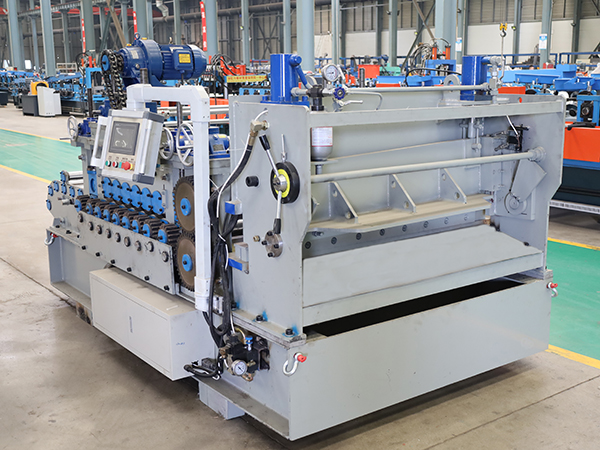
Slitting divides a wide coil into multiple narrower strips by passing the material between stacked circular knives mounted on arbor shafts. The top arbor carries knives arranged across the strip width, and the bottom arbor mirrors this arrangement with paired knives that provide the shearing action. As the coil passes between the rotating knives, the strips are separated cleanly along their length.
The quality of the slit edge determines whether the strips are suitable for further processing. A properly executed slit produces clean, straight edges with minimal burr. Poor slitting — ragged edges, excessive burr, or camber (curved strip edges) — creates downstream problems in roll forming, pressing, or welding operations that depend on accurate strip geometry.
High-speed slitting lines are designed for service centers and steel distributors who process large coil volumes daily. These lines typically run at speeds of 150 to 300 meters per minute, with automated coil handling on both the entry and exit sides. Entry coils can weigh up to 25 tons, and exit coils are collected on recoilers that wind the slit strips into individual coils ready for storage or dispatch.
A well-configured high-speed slitting line includes tension leveling stations between slitting and recoiling. Tension leveling applies controlled longitudinal stress that flattens any波浪 (wave) or camber introduced by the slitting process, producing strips with excellent flatness and dimensional stability. Without tension leveling, slit strips may coil unevenly and create handling difficulties for downstream customers.
Materials such as pre-painted steel, high-strength alloy, and stainless steel require more controlled slitting conditions than standard structural steel. Precision slitting machines for these materials feature slower running speeds (typically 30 to 80 meters per minute), finer knife clearance adjustments, and sometimes circular shear blades rather than straight knives for applications where edge quality is critical.
For pre-painted coils, the slitting operation must avoid damaging the paint film along the slit edge. Knife quality, material hardness, and clearance setting all influence whether the coating remains intact. Suppliers experienced in processing pre-painted material will have developed specific tooling configurations that minimize coating chip-off — a detail that matters enormously to customers who specify painted panels for architectural applications.
The knives on a slitting line are a recurring consumable cost. High-speed tool steel knives may need resharpening every 8 to 12 operating hours, while tungsten carbide knives offer longer intervals but higher replacement cost. Factories that process abrasive materials or high-tensile-strength steel will find their knife consumption significantly higher than those processing standard mild steel.
Developing a knife inventory management system that tracks usage by material type and optimizes resharpening schedules reduces operating cost without compromising slit quality. Some suppliers offer knife coating services — titanium nitride or similar hard coatings — that extend effective knife life and reduce the frequency of replacement.
When assessing slitting equipment, the key specifications to review are maximum coil width, minimum strip width, thickness range, line speed, and exit coil weight capacity. Consider also whether the machine can handle multiple material grades, because diversifying your product mix is a common growth path for steel processing operations. A flexible machine that handles both structural steel and precision strip reduces the need for multiple dedicated pieces of equipment.
Ask the manufacturer for reference customers in your industry segment and visit an operating installation if possible. Observing the machine running live, and talking to the operators about real-world performance and maintenance experience, provides insight that specification sheets alone cannot convey.
Selecting the right slitting machine requires matching your production volume, material specifications, and quality requirements to the appropriate equipment class. High-speed lines serve high-throughput service centers, while precision slitters handle specialty materials with tighter tolerances. Understanding knife maintenance costs, tension leveling capabilities, and recoiler configuration options helps you evaluate proposals from different suppliers and make an investment that serves your operation well for many years.
Sato, K. and Hoffman, T. (2019). Fundamentals of Metal Slitting and Edge Quality Control. Journal of Steel Processing and Production, 56(12), 804-819.
BSI Standards Institution. (2021). Specification for Slitting and Cut-to-Length Lines for Steel Strip Processing. British Standard BS EN 10163, Part 3.
Miller, D. and Tanaka, H. (2023). Advances in Precision Slitting Technology for High-Strength Steel Alloys. International Journal of Materials Processing Technology, 312, 118-135.

Copyright © 2026-2027 Mingmu Roll Forming Machinery Manufacture All Rights Reserved