


Release time:2026-07-20 22:02:56 view count:78
Choosing between roll forming and press brake bending is one of the fundamental decisions a fabrication shop or manufacturing facility faces when planning its production process. Both methods transform flat metal sheets into shaped profiles, but their operational characteristics, cost structures, and quality outcomes differ substantially. Making the right choice for your specific application depends on understanding these differences clearly.
A press brake is a machine that bends sheet metal by pressing it between a punch and a die mounted on amoveable upper beam and a fixed lower table. The operator programs the bend angle, position, and material thickness, and the machine performs each bend sequentially. Each bend is created independently, which means a complex profile with multiple bends requires multiple operations on the same or different machines.
Press brakes are versatile machines capable of producing a wide variety of shapes and profiles, including those with non-repeating geometries or custom one-off designs. This flexibility makes press brakes the equipment of choice for shops handling low-volume, high-variety production runs or projects requiring unique profiles that would not justify the tooling investment of a dedicated roll forming setup.
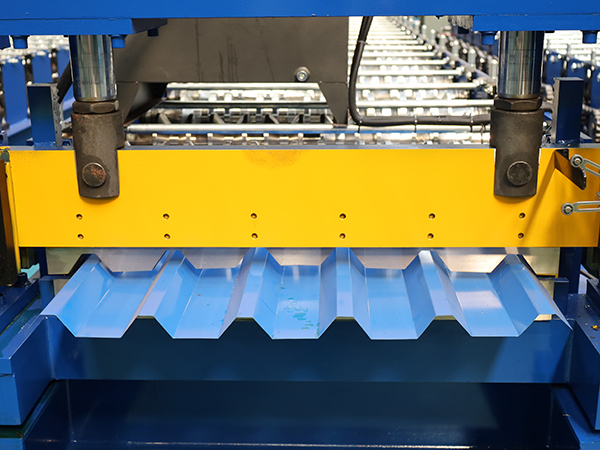
Roll forming takes a fundamentally different approach. Instead of bending the material at discrete stations, it passes a continuous strip of metal through a series of roller pairs, each pair adding a small increment of shape. The cumulative effect of all the roller stations produces the final profile in a single continuous pass through the machine.
This continuous process offers significant advantages when producing long lengths of repeating profiles. Once the rollers are configured for a specific profile, the machine produces identical pieces indefinitely with minimal operator intervention. This consistency is difficult to achieve with a press brake, where each bend operation introduces the possibility of variation depending on operator technique, material springback, and machine setup.
For long production runs of standard profiles, roll forming typically outperforms press brake bending by a wide margin. A roll forming line can process material continuously at speeds of 10 to 60 meters per minute, producing hundreds or thousands of identical pieces per hour depending on the profile and material. Press brake operations, by contrast, require the material to stop for each individual bend, and a typical bend cycle takes anywhere from 1 to 5 seconds plus handling and positioning time.
The throughput advantage of roll forming becomes even more pronounced when dealing with profiles that require many bends. A complex profile with 20 bends that would take the press brake operator several minutes per piece can be produced continuously on a roll forming line at rates measured in linear meters per minute.
Roll formed profiles exhibit exceptional dimensional consistency from the first piece to the ten-thousandth. The fixed geometry of the rollers and the continuous feeding mechanism ensure that every panel or section produced shares the same cross-sectional dimensions. This repeatability is critical for applications where panels must interlock, overlap, or fit precisely with other components during installation.
Press brake quality depends heavily on operator skill and the consistency of material properties. Springback—the tendency of bent metal to partially return to its original shape when the pressing force is released—varies with material grade, thickness, and grain direction. Managing springback requires experienced operators who can compensate appropriately, and even skilled operators may produce slight variations between pieces over long runs.
Initial equipment cost favors press brakes for low-volume operations. A capable press brake represents a relatively modest capital investment compared to a fully equipped roll forming line with multiple roller stations and automated handling systems. For a factory producing limited quantities or frequently changing product types, a press brake may offer a better return on investment.
However, for high-volume production of standard profiles, roll forming delivers lower per-piece costs due to its speed, reduced labor requirements, and minimal material waste. When production runs extend into thousands of identical pieces, the economies of roll forming quickly offset the higher initial equipment cost. A well-run roll forming factory can often undercut press brake pricing for standard profile work while delivering superior quality consistency.
Roll forming is the clear choice for high-volume production of repeating profiles such as roofing sheets, purlins, ceiling grids, and structural sections. The capital investment is justified when annual production volumes are substantial and the profile geometry remains stable over time. Press brake bending remains the preferred method for prototyping, custom one-off work, complex geometries with compound bends, and shops with highly variable product mixes.
Many successful fabrication facilities operate both methods, using press brakes for custom and short-run work while dedicating roll forming lines to standard high-volume production. This hybrid approach maximizes flexibility while capturing the cost and quality benefits of roll forming for the bulk of the facility's output.
Neither roll forming nor press brake bending is universally superior—the right choice depends on production volume, profile complexity, quality requirements, and economic factors specific to your operation. Understanding these trade-offs enables informed investment decisions that optimize both equipment utilization and product economics for the long term.
References
CRC Press – Roll Forming Handbook, 2nd Edition, Bagheripoor and Hatvani.
Society of Manufacturing Engineers (SME) – Metal Fabricator's Handbook of Press Brake Technology.
Journal of Materials Processing Technology, Vol. 209, 2018 – Comparative Analysis of Roll Forming and Press Brake Processes in Sheet Metal Fabrication.
Tool and Manufacturing Engineers Handbook (SME), 5th Edition – Volume on Sheet Metal Forming Processes.

Copyright © 2026-2027 Mingmu Roll Forming Machinery Manufacture All Rights Reserved