


Release time:2026-06-23 09:45:09 view count:186

Automated roofing sheet machines integrate multiple functions into a single production unit: decoiling, feeding, profile forming, cutting, and stacking. The coordination between these stages is managed by a programmable logic controller that monitors process parameters in real time and adjusts machine behavior automatically. This level of integration eliminates the variability introduced by manual operation, where an operator's reaction time and attention consistency directly affect output quality.
The PLC system enables batch programming — the operator enters panel length, quantity, and material thickness once, and the machine executes the entire run without further input. Automatic length measurement during cutting ensures each panel meets the specified dimension on the first pass, reducing scrap rates to under 2% on well-configured lines.
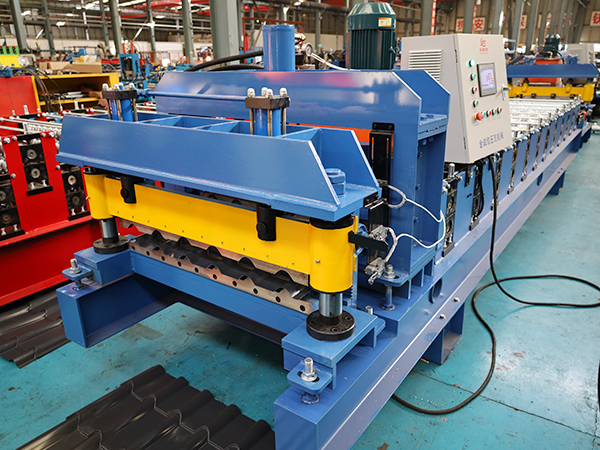
Servo feeding systems represent one of the most impactful upgrades available on modern equipment. Unlike friction or gear-driven feeders, servo motors provide precise, repeatable strip advancement with virtually zero slip. This precision translates directly to tighter length tolerances and eliminates the cumulative error that can develop over long production runs with mechanical feeding systems.
Hydraulic or servo-controlled flying cutoff shears handle high-speed cutting without halting the forming process. The cutting head travels in synchronization with the strip, completing the cut while material continues moving through the rollers. This flying-shear design enables cutting speeds that match the fastest forming rates, keeping the line operating at full capacity throughout the run.
Automatic stacking and bundling systems reduce the labor requirement per ton of output. Finished panels are guided into neatly stacked bundles, counted, and strapped automatically. In high-volume factories, this feature alone can reduce labor costs by 40% compared to manual stacking operations.
An automated line is only as efficient as its slowest station. If the decoiler struggles to maintain tension during acceleration, or if the cutoff cycle cannot keep pace with the forming speed, the entire line backs up. Evaluating the balance of your production line — identifying bottlenecks and distributing work across stations — is a continuous optimization process.
Modern equipment suppliers often provide simulation software that models line performance based on speed settings, material thickness, and profile complexity. Before purchasing a new line, ask the manufacturer to run a simulation that identifies the theoretical maximum throughput for your specific product range. This data informs realistic production planning and prevents over-promising on delivery timelines.
The sophistication of automated equipment demands well-trained operators. Even the most capable machine underperforms when operated by staff who have not received structured training on its control interface, diagnostic procedures, and troubleshooting protocols. A reputable supplier will provide comprehensive operator training at the time of installation and make technical documentation available for ongoing reference.
Establishing written work instructions for each product type — including recommended speed settings, roller pressures, and inspection checkpoints — ensures consistent output regardless of which operator is running the line. Factories that maintain up-to-date process documentation consistently achieve higher first-pass yield rates and shorter changeover times between product profiles.
Automated roofing sheet machines offer significant advantages in throughput, consistency, and labor efficiency, but realizing those benefits requires proper configuration, operator competence, and disciplined maintenance. Factories that invest in understanding their equipment's full capabilities — rather than simply running material through it — consistently outperform competitors who treat automation as a set-and-forget solution. The most productive operations are those that treat their machines as systems requiring ongoing optimization, not just machines requiring operation.
Kim, S. and Patel, N. (2020). Advances in Automated Roll Forming Systems for Metal Panel Manufacturing. Journal of Industrial Automation, 28(4), 331-348.
Metal Construction Association (MCA). (2022). Best Practices for High-Speed Roll Forming Operations. MCA Technical Publication No. 21-07.
Chen, H. and Roberts, P. (2023). Productivity Optimization in Cold Metal Forming Production Lines. Manufacturing Engineering Quarterly, 15(2), 88-103.

Copyright © 2026-2027 Mingmu Roll Forming Machinery Manufacture All Rights Reserved