


Release time:2026-09-22 10:36:48 view count:77
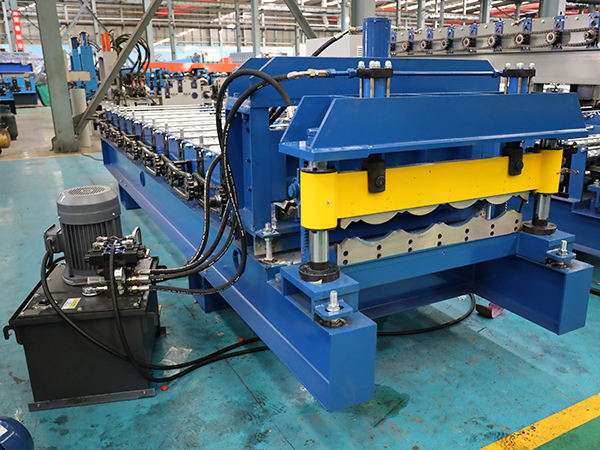
Glazed tile sheet is what people picture when they think of a tiled roof, except the tile arrives out of a steel coil instead of a kiln. A glazed tile roof sheet roll forming machine presses a repeating crown-and-step pattern into painted strip, so a house or a light industrial shed gets the traditional look at a fraction of the weight. The product sells on appearance, and that changes the engineering: the line has to hold a shape that the eye judges, not just a dimension a tape measure checks. Anyone who has watched a badly formed tile panel lie crooked across a roof knows how visible small errors become once ten sheets sit side by side.
A trapezoidal panel is straight lines and simple angles, and it can be shaped in a handful of stations. A tile profile is a run of rounded crowns with a step between each course. Curves cannot be forced in two or three passes without tearing the paint, so tile lines carry far more stations, commonly fourteen to twenty depending on profile depth and material thickness. Each pass takes the strip a little further, and the steel work-hardens along the way. Squeeze the bend into too few stations and the coating cracks at the crown or the sheet springs back unevenly; spread it properly and the tile comes off the line clean with the finish untouched.
Tile profiles are usually quoted by feeding width and finished covering width. Numbers such as 800 or 828 refer to how much roof the sheet actually covers once the side lap is taken into account, not to the width of the coil entering the machine. This is where buyers get caught: two machines that consume the same coil can leave quite different usable coverage, and the difference quietly changes how many sheets a job needs. A supplier quoting per linear metre while you are costing per square metre of finished roof is comparing two different things. Ask for the covering width in writing and recalculate your own quantities from that figure.
Some machines form the entire tile pattern in the roll passes. Others run the sheet through a hydraulic press station after forming, which stamps the step across the width in one stroke. The pressed route gives a crisper step and handles shallower coils well, but it adds a cycle to every sheet and a set of wearing parts to maintain. The rolled route keeps the line running continuously and suits long runs. Neither is universally better; the right one depends on whether you are chasing a sharp decorative edge or plain throughput. A manufacturer with both designs in its workshop can usually tell you honestly which suits your profile.
Tile sheet is nearly always pre-painted, which means the coating has to survive the forming. Polyester-coated galvanised strip in the 0.3 to 0.5 mm range covers most residential work, while aluminium-zinc substrate earns its keep near the coast or around industrial air. Thicker steel holds the crown more sharply but fights the rolls harder and wears them faster. Before ordering, state the full material range you intend to run, not just the grade you plan to use most, because rollers cut for thin painted strip will struggle the day someone feeds heavier coil through them.
Curved profiles spring back more than angular ones, so each station is ground with a deliberate overbend, and the amount is a judgement call based on yield strength and thickness. That is why a machine set perfectly on one coil can drift on another from a different mill. Good tile lines give independent vertical and side adjustment per station so the operator can chase the shape back. Check the first sheet from a new coil against a sample you have kept, and check it again after twenty metres, because a profile that looks right on the first cut often relaxes as the rolls warm up.
Tile sheet is cut by a hydraulic shear shaped to the profile, or by a blade that follows the crown. A blade ground for the wrong profile leaves a burr that shows as a dark line along every lap. Sheet ends should be squared to the profile, not just to the strip, or the courses will not line up down the roof. At the exit, tiles should stack on their crowns rather than on their edges, since a heavy pile resting on a formed step will flatten it. Small details, but they decide whether the stack arrives looking like a product or like scrap.
Buy from a manufacturer that runs the profile on its own floor before shipping and sends you those sample sheets. Ask what the roller material is, how it is hardened, and whether spare rolls for your exact profile are kept in stock. Confirm the covering width, the material range, the number of stations and the cut method in the contract rather than in a sales message. A factory that answers those questions with drawings and measured samples will treat your production the same way. One that answers with adjectives usually will not.
ASTM International. ASTM A653/A653M, Standard Specification for Steel Sheet, Zinc-Coated (Galvanized) or Zinc-Iron Alloy-Coated (Galvanized) by the Hot-Dip Process.
ASTM International. ASTM A792/A792M, Standard Specification for Steel Sheet, 55% Aluminum-Zinc Alloy-Coated by the Hot-Dip Process.
European Committee for Standardization. EN 10143, Continuously hot-dip coated steel sheet and strip - Tolerances on dimensions and shape.
Metal Construction Association. Metal roofing systems technical resources.
ISO. ISO 9001:2015, Quality management systems - Requirements.

Copyright © 2026-2027 Mingmu Roll Forming Machinery Manufacture All Rights Reserved