


Release time:2026-09-22 10:35:39 view count:100
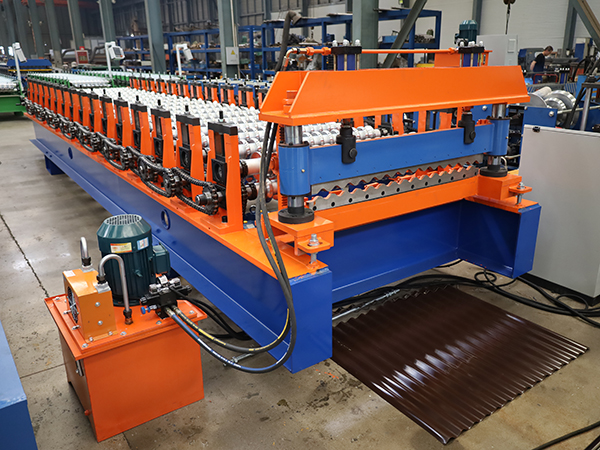
Floor deck is the one roofing-adjacent product where the sheet carries structural load before anyone thinks about weather. A floor deck roll forming machine turns galvanised coil into a ribbed panel that acts as permanent formwork for a concrete slab and, in composite designs, works together with the concrete once it cures. Because the panel is structural, the tolerance expectations are tighter than on a roof sheet, and the coils are heavier. Shops that move from roof sheet into decking usually find the learning curve sits less in the machine and more in the material.
The ribs give the panel stiffness over the span between beams while it is supporting wet concrete on its own. Deeper ribs span further, which is why deck depths in the 50 to 76 mm range dominate commercial work. Alongside the rib geometry, most deck profiles carry small embossments pressed into the web. Those little deformations are not decoration; they are what lets the concrete grip the steel so the two act compositely once the slab has cured. A machine that forms the ribs accurately but flattens the embossments is producing a panel that looks right and performs wrong.
Embossments are formed in dedicated stations where upper and lower rolls press the pattern into the web. Too little pressure and the pattern is shallow, reducing bond; too much and the web thins and the coating is disturbed. Because the pattern sits on a flat area between ribs, any inconsistency in roll gap shows immediately as a patch of light and dark across the sheet. On a well-set line the embossment depth is checked with a gauge at the start of each coil, the same way a printer checks registration. It takes a minute and it prevents a structural complaint months later.
Decking usually runs in 0.75 to 1.5 mm material, which is considerably heavier than roof sheet, and the coating is typically hot-dip zinc in the Z275 or G90 class rather than the lighter pre-painted coils used for roofing. The line therefore needs a decoiler with real capacity, a stronger drive and a shear rated for the thicker section. Feeding heavy coil into a machine built for 0.4 mm roofing stock is the fastest way to wreck a gearbox. Confirm the full thickness range at the design stage, because the motor, the shafts and the shear all follow from the top end of that range.
Deck panels overlap along their side laps, and the ribs are shaped so one panel nests into the next. If the rib geometry drifts even a couple of millimetres, panels refuse to nest on site and the crew starts forcing them, which is how laps end up open and concrete leaks through. This is the single most common complaint on decking jobs, and it nearly always traces back to a profile tolerance rather than to a bad installation crew. Ask the factory to demonstrate nesting with three consecutive panels cut from a running coil, not from hand-picked samples.
Decking is cut to span length, and the ends bear on steel beams. A panel cut even three millimetres out of square leaves a gap along the bearing, and a panel cut short does not reach the beam at all. Length tolerance and squareness therefore matter more here than on any roofing profile. Modern lines measure with a rotary encoder on the strip or with a servo feed, and a flying shear cuts without stopping the line. Confirm which arrangement you are buying, because a stop-and-cut shear on thick deck is slow and tends to mark the sheet where it pauses.
Deck panels are long, heavy and awkward. The run-out has to support them without bending the ribs, and the stacker needs to lift panels off rather than slide them across each other, since dragging a galvanised panel over another one scores the coating. Bundling with separators and strapping tightly for transport sounds mundane, but damaged bundles are the most frequent cause of disputes between a supplier and a contractor. Sort the exit handling before worrying about maximum line speed; a line that runs fast and stacks badly produces more waste than a slower one that handles the panel gently.
Look for a manufacturer that has built decking lines before and can show the rib drawings it works to, with the embossment pattern specified. Ask what the shafts and bearings are rated for at your maximum thickness, and whether the shear is a flying type. Confirm that the factory will run your profile on your specified coil during acceptance and will record the measurements. A supplier thinking in those terms is thinking about your production; one quoting only speed and price is selling you a machine and leaving the problems to you.
Steel Deck Institute. ANSI/SDI C1.0, Standard for Composite Steel Floor Deck.
Steel Deck Institute. ANSI/SDI NC1.0, Standard for Non-Composite Steel Floor Deck.
ASTM International. ASTM A653/A653M, Standard Specification for Steel Sheet, Zinc-Coated (Galvanized) by the Hot-Dip Process.
American Institute of Steel Construction. ANSI/AISC 360, Specification for Structural Steel Buildings.
ISO. ISO 9001:2015, Quality management systems - Requirements.

Copyright © 2026-2027 Mingmu Roll Forming Machinery Manufacture All Rights Reserved