

Release time:2026-06-09 21:30:50 view count:97
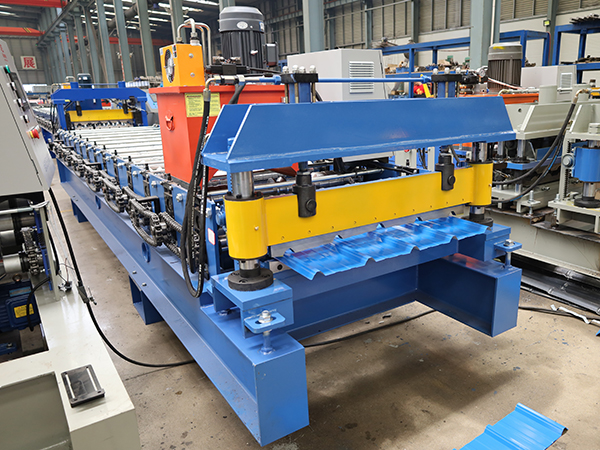
Purchasing a roofing machine represents a major capital commitment. Beyond the purchase price, multiple factors determine the actual return on that investment over the equipment's lifetime. A thorough cost analysis before purchasing prevents the disappointment of discovering that a machine which seemed economical on paper is actually eroding profitability through high operating costs or limited market versatility.
The purchase price of a roofing machine varies widely based on configuration, automation level, and manufacturer. A basic entry-level line may cost less than a fully automated system with integrated cutting, stacking, and programmable control. However, the relationship between purchase price and cost per unit of output is more important than the price tag alone.
Financing a purchase through equipment loans or leasing arrangements affects the total cost of ownership. Leasing preserves working capital and can offer tax advantages through deductible lease payments, but the total interest cost over a three-to-five-year term adds meaningfully to the purchase price. Evaluate the after-tax cost of each financing option against your cash flow position and growth plans before deciding.
Labor cost per panel is the most variable component of the operating cost structure. A manual or semi-automatic machine requires one or two operators for each shift, while a highly automated line can produce the same output with a single operator plus occasional supervision. Calculate the labor cost per shift against the expected production volume to determine whether automation delivers a meaningful reduction in per-unit labor cost.
Energy consumption scales with line speed and the number of motors on the machine. A servo-driven automated line with multiple axis controls draws more power than a simple mechanical line, but produces more panels per hour, so the energy cost per panel may be comparable or lower. Request energy consumption data from the manufacturer and estimate costs based on your local electricity rate to build an accurate operating cost model.
Every machine requires ongoing maintenance, and the cost is proportional to how hard it is worked. A production line running three shifts per day through a busy construction season will incur significantly higher maintenance costs than one running a single shift, five days a week. Ask the manufacturer for a maintenance cost estimate based on your expected production hours, and plan a budget that covers routine servicing, wear parts replacement, and contingency for unexpected failures.
The availability and cost of spare parts vary considerably between suppliers. A manufacturer that builds components in-house can supply replacement parts quickly and at controlled prices. A supplier that sources components from multiple third parties may face longer lead times and higher costs when parts are needed. Verify the supplier's spare parts policy and typical delivery times before purchasing — this information often proves more valuable than the technical specifications when the machine has been running for several years.
The revenue potential of a roofing machine is determined by its maximum throughput and the utilization rate you can achieve. A machine capable of 200 panels per shift at 90% utilization will generate significantly more annual revenue than one capable of 150 panels at 70% utilization — even if the higher-throughput machine has a higher purchase price. Model utilization scenarios conservatively; overestimating utilization is one of the most common mistakes in equipment investment analysis.
Consider how market demand for your products will evolve over the machine's economic life. If your market is growing and you anticipate needing additional capacity within three to five years, investing in a machine with higher rated capacity may be smarter than buying the cheapest option that meets today's requirements. A manufacturer with modular design capabilities can often supply upgrades — additional roller stations, faster cutting systems — that extend the machine's productive capacity without requiring a full replacement.
The basic ROI formula for a roofing machine investment compares the net annual revenue contribution (output value minus operating costs) against the total capital deployed. A healthy target for manufacturing equipment is recovery of the initial investment within 24 to 36 months. Machines that take longer to pay back tie up capital in depreciating assets and carry higher risk if market conditions change.
Build the model with three scenarios: conservative, expected, and optimistic. Each scenario should vary the assumptions about utilization rate, product pricing, and operating cost. Reviewing all three scenarios before committing to a purchase ensures that the investment decision is resilient to unfavorable outcomes rather than dependent on every assumption proving correct.
A comprehensive investment analysis considers not just the purchase price but the full cost structure over the machine's operating life. Labor efficiency, energy consumption, maintenance costs, spare parts availability, and realistic capacity utilization all feed into the ROI calculation. Factories that conduct this analysis rigorously before purchasing consistently achieve better investment outcomes and avoid the common trap of optimizing solely on acquisition price.
Brealey, R., Myers, S. and Allen, F. (2022). Principles of Corporate Finance. 14th Edition, McGraw-Hill Education, Chapters 10-12.
Slack, N. and Brandon-Jones, A. (2021). Operations Management. 10th Edition, Pearson Education, Chapter 6: Capacity Planning.
Institute of Industrial and Systems Engineers (IISE). (2023). Economic Analysis of Manufacturing Equipment Investments. IISE Technical Reference TR-2023-08.
Copyright © 2026-2027 Mingmu Roll Forming Machinery Manufacture All Rights Reserved